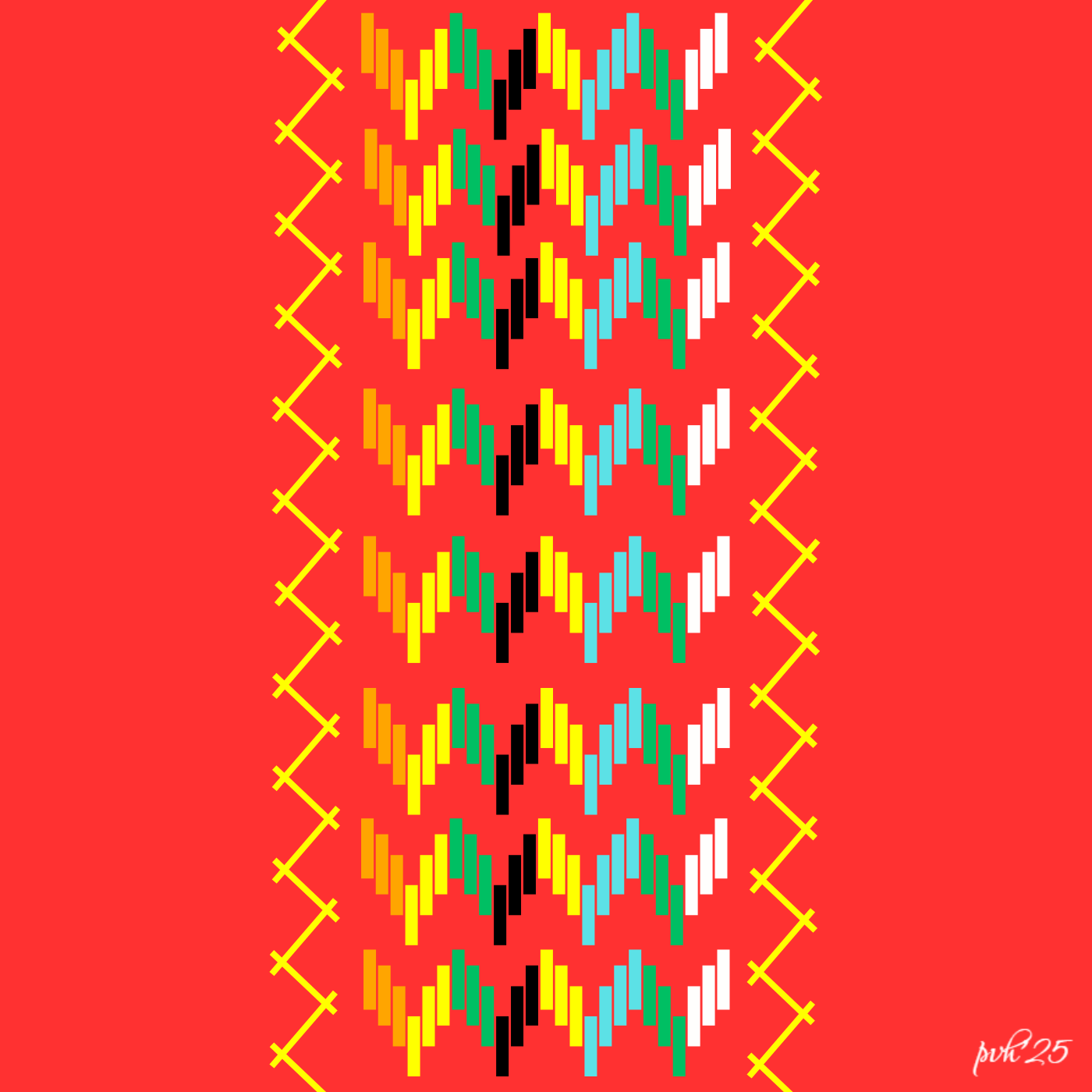
binunghay
Decolonial Minimalism Founding Work (Culture - Habi)
Size: 1400 x 1400 pixels
Medium: Digital Art
Artist: IJWBAA
Year: 2025
Description:
IJWBAA’s Binunghay serves as a definitive manifesto on decolonial minimalism, stripping back the sacred, compound patterns of the Panay Bukidnon Panubok tradition to reveal their core structural power. By distilling the intricate zigzag geometry of the binunghay—a motif born from ancestral memory—into its most elemental form, the artwork challenges the colonial tendency to view indigenous crafts as merely "ornamental" or "complex." Instead, the piece asserts that these patterns possess an inherent, sovereign logic that does not require layers of western-style artistic embellishment to be profound; their simplicity is, in itself, an act of resistance.
Set against a stark, uncompromising red field, the digital rendering of the pattern demands absolute clarity and focus. This intentional use of high-contrast, geometric precision distances the work from the "rustic" or "folkloric" labels often imposed by outsiders, reframing the binunghay as a sophisticated, mathematical blueprint. The repeating vertical rhythm captures the pulse of the habi, yet it is presented with a modern sharpness that declares Filipino indigenous design is not a static artifact of the past, but a living, evolving infrastructure for contemporary identity.
Ultimately, this work reframes the traditional weave as a visual statement of artistic sovereignty and "absolute" truth. By reducing the motif to its foundational essence, IJWBAA demonstrates that indigenous storytelling can dominate modern spaces without losing its ancestral soul. Binunghay is presented not as a mere abstraction, but as a foundational pillar for the future—a reminder that the rhythms of the Panay Bukidnon ancestors are the very blueprints upon which a decolonized Filipino visual language is built.
Featured On
Website:
coming soon
Social Media:
coming soon
Media:
coming soon
Publication:
IJWBAA. Decolonial Minimalism. Photobook, mm/dd/yyyy, p. #. - coming soon
Exhibitions:
Paper:
coming soon